When you want a message, such as a changeFont: Hopefully this has helped to demonstrate, albeit on a small scale, the capabilities of Gorm. You should see the following: Once the inspectors window is up move the pulldown on the top to "Attributes" and select the class you created which should, at this point, have the name "NewClass". Whichever object has First Responder status will be tested to see if it responds to this method. You should see a open dialog open. The title of the instantiated Window will automatically change.

| Uploader: | Grolkis |
| Date Added: | 25 December 2018 |
| File Size: | 19.52 Mb |
| Operating Systems: | Windows NT/2000/XP/2003/2003/7/8/10 MacOS 10/X |
| Downloads: | 29035 |
| Price: | Free* [*Free Regsitration Required] |

GNUstep development tools : a basic tutorial
These include a map which maintains the relationships between the objects themselves, a map which maintains the relationship between each object and it's name, a map which holds the relationship between an object and it's custom class and an array of torm which will determine how all of the objects messages and outlets are connected.
When you look at the.
In the code, you'll add a method called "- void finishInstantiate" leave it empty for now. At this point you must save the. This article does not cite any sources.
You should not release any objects in this method. After the palette is built you're ready to load it into Gorm. These are necessary prerequisites to understanding some of the technical yorm and examples given here.
You can also change the name in the NSMenuItem attributes inspector. Do a drag-and-drop with gnustpe control key pressed, from the Convert button to the instance of ConvertorManager. Connections Array - This array is used to form the connections after the.
The collection of objects is then saved as a document which can either be re-loaded into Gorm for further editing, or can be loaded into a running GNUstep application in order to provide gnustrp application with a user interface or some subsystem. The IB documentation on how object selection is managed and gnistep editors and inspectors are used is unclear How can you get your classes into Gorm, you say?
Move things in order to obtain an interface that looks close to the following one.
If the Palettes and Ggorm don't display automatically for you, show them using: The connections inspector should again appear. It will be called "NewClass" You should then see the following inspector window.
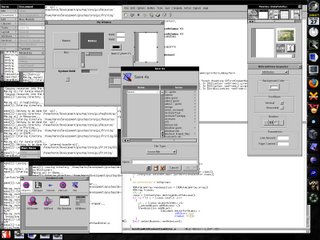
File:Gnustep-gorm.jpg
An action is an object method which can be linked to interface's component at design time, so that a specific action on the component will get this method to be called.
MyController" in the Connections section of the inspector. In this way, because you're literally linking the class into Gorm, you're making the class and it's structure known to Gorm so that it can encode the class directly. Free and open-source software portal. As you may have guessed, the amount outlet is to be connected to the first text field, rate to the second and result to the third.
This means that, for any given app, there should be only one instance of the object. You then need to select the Document menu, and then New Application.
In the following sections you will learn more about it Select the first palette in the palette window, this should be the MenusPalette. Gorm Graphical Object Relationship Modeller is a graphical user interface builder application. This chapter describes some details about implementation of various features of Gorm.
For the purposes of our example we'll call it MyPalette. Initially a close clone of the old NeXTstep 3. You should now see a new object ConvertorManager in the Objects part of Gorm's main panel. Rename the class from NewClass to ConvertorManager don't forget to press Enter, or your change will not affect anything.

We'll discuss more about this later when we go gnustsp how to create a new application. Drag the items you need from the Palette Controls Palette.

Комментарии
Отправить комментарий